Why Missing Out on These 5 Simple Services Can Shorten the Life of Your Car by Half
Most people overlook simple car services, and in this blog, we are going to discuss five of them and the reasons why they should not be ignored because they can result in premature wear and tear, safety issues, and huge repair expenses or, even worse, a completely wrecked car way earlier than imagined.
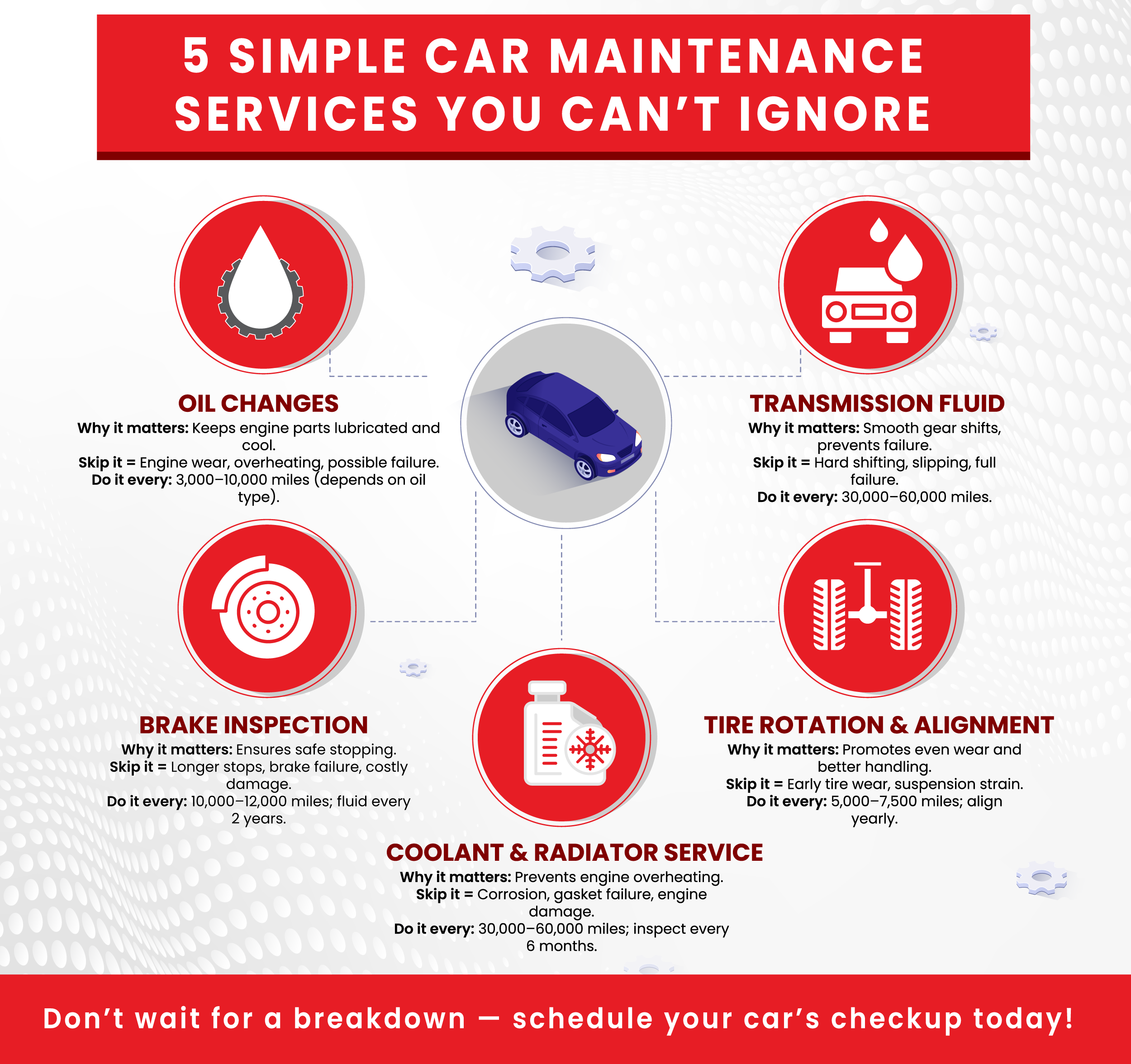
1. Oil Changes: Keeping Your Engine Alive
The engine oil keeps your car alive. It also lubricates engine parts, builds up less friction and manages heat. Oil deteriorates with time and gets contaminated and inefficient. When you neglect to have the oil changed on a regular basis your engine must continue to work with either dirty oil or without enough lubrication.
Effects of not doing it:
- Wear and tear: Contaminated oil will enable metal to metal contact, which is irreversible and may destroy engine parts such as pistons, bearings and camshafts.
- Overheating: Used oil has poor dispersion of the heat, and there are chances of engine overheating and warping.
- Engine failure: Should sludge form or the oil levels become too low then the engine may seize resulting in a devastating failure.
The ways it can make your car lessen its life:
Several skipped oil changes are enough to considerably decrease the efficiency of an engine. This wear adds up after a while and the engine can break down long before it reaches 100,000 miles which is far from much below the average lifespan of a well-maintained car.
Recommended frequency:
- Conventional oil: Every 3,000-5,000 miles
- Synthetic oil: Every 7,500 -10,000 miles (again, depending on your car and how you drive it)
2. Brakes System Inspection & Maintenance
Pads and rotors are not the only elements that constitute your brake system as there are calipers, fluid, and lines. This inevitability is a safety and drivability system. Brake pads get worn out, rotors can warp, and brake fluid may get mixed with moisture in the course of time.
Effects of not doing it:
- Longer stopping distance: If the pads or the rotors are worn, they may severely decrease the braking effectiveness.
- Brake failure: The old fluid absorbs moisture, which causes rusting of the brake lines, and they might fail under pressure.
- Rotors and calipers damage: When neglecting the squeaking or grinding sound, the damage can be much more expensive than a regular pad change.
The ways it can make your car lessen its life:
Malfunctioning brakes may cause accidents or other components of your vehicle to get spoilt. Even when a crash is evaded, overheated brake parts compromise the general suspension and steering parts, causing additional wear to your car.
Recommended frequency:
- Brake check: In every 10,000-12,000 miles
- Brake fluid: Replace every 2 years or as specified by the manufacturer
- Pad replacement: Every 25,000-50,000 miles (depends on driving style)
3. Tire Rotation, Balancing and Alignment
The only contact your car has with the road is through the tires. Tire rotation, alignment and balancing should be done regularly to wear the tires evenly and provide maximum handling.
Effects of not doing it:
- Uneven tire wear: May cause uneven tire wearing resulting into early tire replacement and poor traction.
- Low fuel gas mileage: Wheels that are out of alignment cause high rolling resistance.
- Damage to steering and suspension: Misalignment causes strains on the steering rack, and the suspension parts.
The ways it can make your car lessen its life:
Out of balance or misaligned tires mean that your suspension has to labor more than necessary and this translates into faster wear and tear of such components as shocks, struts, and control arms. It also, altogether, reduces the price of prematurely replacing tires, which can be quite expensive–not to mention the fact that low tread depth may cause unsafe driving.
Recommended frequency:
- Tire rotation: Every 5,000 – 7,500 miles
- Wheel alignment: Once a year or when uneven wear is detected
- Tire balancing: Every rotation or when you experience vibrations
4. Coolant Flushes & Radiator Service
Cooling system in your car controls the temperature in the engine and ensures the engine does not overheat. Coolant might also get acidic with time thereby becoming ineffective. Scales, rust, and failure of the radiator or water pump may occur due to infrequent service of the coolant, which may cause serious engine damage.
Effects of not doing it:
· Overheating: Among the most widespread causes of chaos, overheating might deform engine parts.
· Corrosion: Outdated coolant becomes ineffective at deterring rust, which can corrode internal parts.
- Failure of head gasket: Head gaskets may be damaged by high temperatures, cause oil/coolant leakage and ultimately result in engine failure.
The ways it can make your car lessen its life:
An engine that has a failed cooling system may be ruined. And one serious overheating event is capable of doing sufficient damage to justify replacing the entire engine- something that can routinely cost more than the car itself.
Recommended frequency:
- Coolant flush: Every 30,000 to 60,000 miles or every 3-5 years
- Radiator inspection: With each oil change or six months
5. Transmission Fluid Service
Transmission fluid is a lubricant and also hydraulic fluid. It ensures smooth shifting of gears, and it avoids overheating. Transmission fluid, similarly, to engine oil, becomes deteriorated and accumulates debris with time.
Effects of not doing it:
- Hard or delayed shifting: degraded fluid is unable to sustain appropriate pressure to achieve smooth engagement of the gears.
- Slipping gears: Whenever there is a slipping transmission, this may result in poor acceleration and power loss.
- Total failure of transmission: A transmission replacement or rebuild is amongst the costliest repairs in automotive care.
The ways it can make your car lessen its life:
A faulty transmission may make your car unusable. A car with a failing transmission is unsafe or impossible to drive, even when the engine is in good condition. The transmission failures usually mark the end of the road of many older vehicles since they are not worth repairing.
Recommended frequency:
- Fluid change: Every 30,000 -60,000 miles (automatic transmissions)
- Manual transmissions: Every 30,000 miles or as mentioned in your owner’s manual