Auto Body Shop vs Collision Repair: What’s the Difference in Reading, PA
In case you are in Reading, PA and in case you have ever required such vehicle repair as that of a fender-bender or a larger collision, you must have come across shops that have advertised themselves as auto body shops, collision repair shops or a combination of both. The two terms are used interchangeably, and they may have different meanings – and that makes a difference when you need a safe, reliable repair job, an easy grab of an insurance claim and the best deal of your money.
This guide will describe the distinction in what to expect with each of these types of shops in Reading, PA, how to select the appropriate facility to work on your vehicle, what your consumer rights are in accordance with Pennsylvania regulations, and how to make the process of the repair less painful.
Body Shop Vs. Collision Repair the Abridged Version
- Auto body shop: Tends to specialize in exterior restoration, paint, dent repair, panel restoration and cosmetic restoration. Ideal in cases of hail damage, minor dents, bumper scratches, paint repairs and panel alignment.
- Collision repair centre: Mostly this one deals with mechanical systems (airbag systems, suspension) damaged in crashes, structural repairs, and overall crash restoration work.
Such facilities are frequently equipped with special machinery, OEMs parts, and specialized technicians to perform their safety-related tasks.
There are independent auto body shops, dealership body shops, and national chain collision centres such as Berks Auto Repair in Reading, each having its own strengths.
The Importance of The Difference (Safety, Value, and Insurance)
In case of a collision with your car, it is not always an aesthetic job, as modern cars include safety mechanisms (crumple zones, sensors, airbags and advanced driver-assistance systems). A paint and dent store may not be well prepared to check or fix damaged safety parts properly. On the other hand, a well-equipped collision repair center will contain frame equipment, computerized measurement tools and technicians with the necessary training to restore a vehicle to factory safety standards.
Insurance companies can provide a list of preferred shops, though Pennsylvania law provides you with the opportunity to select your repair shop. It means that you can (and must) choose your repairer based on safety and quality selection instead of letting the insurer to choose one by default.
What Each of These Can Offer You as a Service
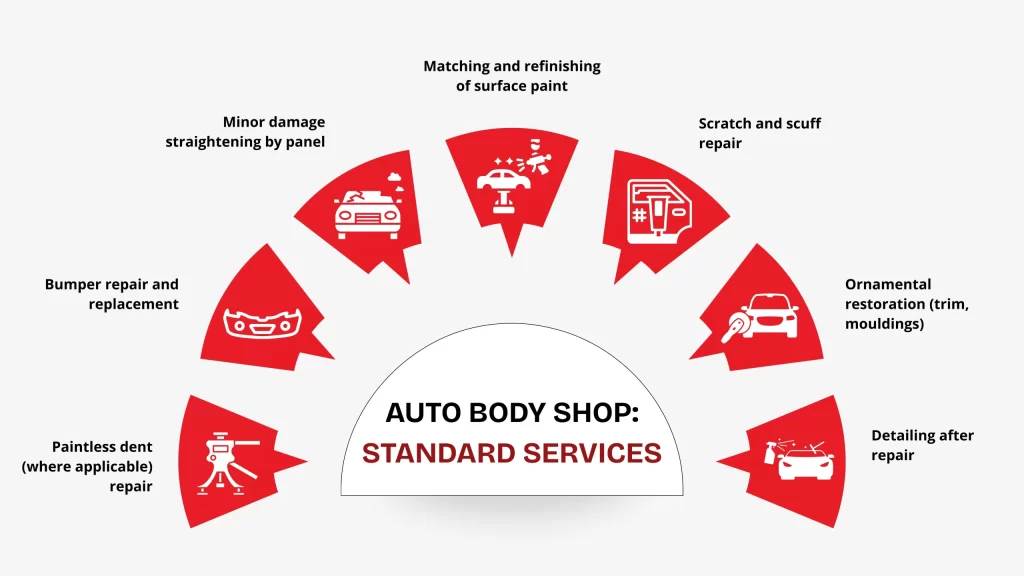
Auto Body Shop: Standard services.
- Paintless dent (where applicable) repair.
- Bumper repair and replacement.
- Minor damage straightening by panel.
- Matching and refinishing of surface paint.
- Scratch and scuff repair
- Ornamental restoration (trim, mouldings)
- Detailing after repair
These stores are ideal in cases of lower impact where the building and safety measures were not affected but the car appearance is damaged.
Collision Repair Center – Standard Services
- Frame and structural straightening.
- Metal fabrication and welding.
- Diagnostic and replacement of airbag and SRS system.
- Repair on suspension and alignment after an impact.
- Integration tests (mechanical) (steering, braking parts, etc.)
- Measuring and calibration (including ADAS where available) are computerized.
- Complete paint and refinish service (including OEM paint often)
- Arrangement of insurers on total-loss assessment.
A collision repair centre will be the correct choice if your car was impacted so that airbags have been deployed, or subframes are bent or the suspension is damaged. Such stores usually contain manufacturer certifications and modern equipment to guarantee that structural and safety repair is performed properly.
Local Scene in Reading, PA – Why Berks Auto Repair?
There are numerous auto body shops and collision repair facilities in Reading and Berks County. With independent garages as small as they are, up to large chains spanning the nation, drivers in the region have a wide range of choices when it comes to repairing their vehicles following an accident. However, it doesn’t necessarily make the choice easier with the presence of options, particularly when you are trying to strike the right balance between quality, cost, and trust.
That is what makes Berks Auto Repair special. We are a locally owned and established shop that, unlike large corporate operations, does not treat its customers like numbers and has served the Reading drivers over the years. We provide the high-quality equipment and professional installers you would find in a national chain, but with the personalized service, openness and culture of a local company.
By selecting Berks Auto Repair you are selecting:
- Skilled technicians that know cosmetic auto body work and structural collision repair.
- High quality repairs such as frame straightener, diagnostics and paint matching technology.
- Friendly insurance service that makes the claims stress-free.
- Local commitment, as we are familiar with our neighbors, and we have a reputation to keep of treating each vehicle as our own.
Therefore, even though there might be dozens of stores in Reading PA that could be worth visiting, Berks Auto Repair offers the best of both worlds: the experience and opportunities of a modern repair shop and the sincerity and goodwill of a local business.
Qualifications, Certifications and What to Consider
The quality of repair facility to choose in Reading, PA is based on the following competence indicators and signs:
- ASE / I-CAR certifications: I-CAR certified or ASE certified technicians have collision repair training. This is particularly relevant in structural work and airbag work.
- Dealer certifications: Numerous dealerships and authorized stores offer OEM-related training and access to precise components and repair procedures (e.g. Honda-certified repair centers). New vehicles that have a manufacturer warranty are frequently better in these shops.
- State of the art tools: Frame machines, computerized measuring systems, paint booths and ADAS (advanced driver-assistance systems) calibration tools.
- Written estimates and warranty: Shops that are reliable will include written estimates, parts sourcing information (aftermarket vs OEM), and warranty on repairs.
- Clarity with insurance: Effective communication regarding what is covered, what is being used and record of any structural repairs.
Pennsylvania does not have any statewide license to repair technicians, so certifications and documented procedures are the best quality indicators. Insist on seeing certifications and warranties prior to the commencement of the work.
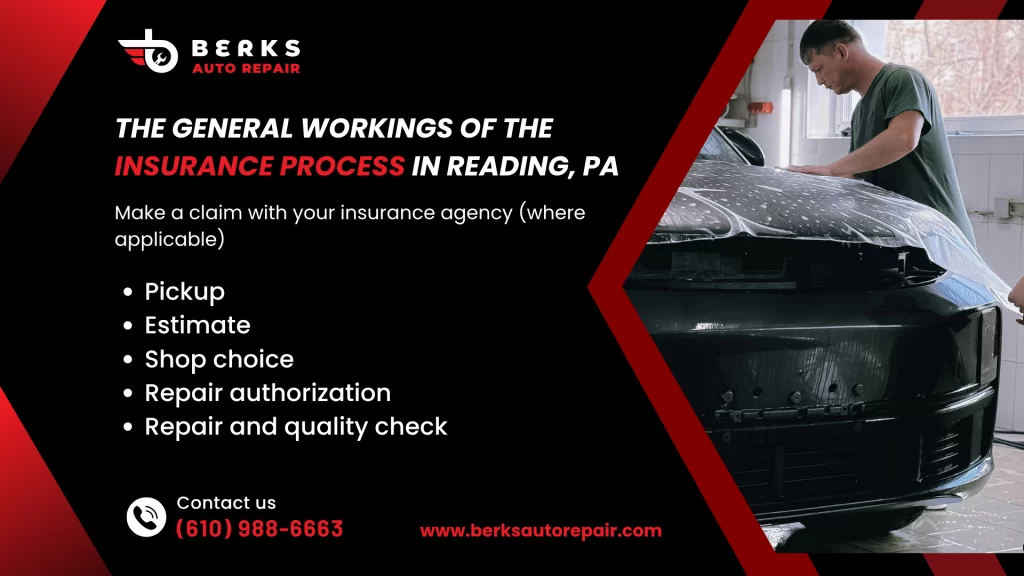
The General Workings of The Insurance Process in Reading, PA
Make a claim with your insurance agency (where applicable).
- Estimate: The vehicle can be inspected by an adjuster, or a digital estimate can be made by the shop.
- Shop choice: You are legally entitled to the choice of repair shop, but the insurer may propose shops. Therefore, choose the one according to safety and certifications, not only convenience.
- Repair authorization: Shop, insurer come to an agreement on scope and parts. Part (OEM vs aftermarket) or procedure disputes are to be written down.
- Repair and quality check: Collision repair shops must finish structural checks, safety checks; body shops must offer final inspection to fit, finish and match paint.
- Pickup: Ask to be walked through at the final and provide documentation of parts and warranties that have been replaced.
Hint: Keep receipts, snap photos prior to repairs and request a written description of the parts utilized (OEM vs aftermarket). When you are not sure about a plan of repair, request a second quotation to a qualified collision repair facility in Reading.
Cost Variations: What Determines the Price?
- Damage extent: Building repairs are even more expensive than paint and small dent repairs.
- Components utilized: OEM components are more expensive than aftermarket alternatives. OEM is usually suggested in the case of safety-critical components.
- Labor rates and equipment: Collision centres that are equipped with modern tools can be charged more hourly but also offer more accuracy and safety returns.
- Complexity of paint and finishing: Metallic and multi-layer painting is very expensive.
- Insurance deductible and coverage: Your out-of-pocket varies depending on your policy.
So, a local body shop may be cheaper with a bumper and paint work, and a collision centre will be more expensive with structural work that may be intricate. However, a cheaper structure may not be a good saving when safety may be at stake.
Should It Be an Auto Body Shop or a Collision Repair Center in Reading?
When you call or visit, ask the following questions:
- What caused the damage? In case of airbags deployment or vehicle pulling to any side following the accident, visit a collision repair center.
- Are you a manufacturer or I-CAR certified? Yes, it is a good indication of structural and safety work.
- You can present past work and give references? Previous repair photos and reviews (Yelp, Google, Carwise) of the area assist.
- Do you carry out post repair safety checks and ADAS Calibration? You must recalibrate your car in case it has lane-keep assist or adaptive cruise.
- What warranty do you offer? Get it in writing.
- Would you be using OEM or aftermarket parts? Ask for a parts list.
- What do you do with insurance claims? A store that has direct contacts with insurers can make it easier.
When the damage is largely cosmetic, paint, minor dents, a good auto body shop in Reading is cheap and quick. Select a collision repair specialist to do any structural, safety system, or alignment work.
How Much of a Realistic Schedule Should Be Expected?
- Minor cosmetic repairs: 1-3 days
- Moderate (panels, bumper, moderate paint): 3-7 days.
- Major collision repair (repair of the structure, ordering of parts, ADAS calibration): 1-3+ weeks.
Depending on the availability of parts and the workload of the shop timeframes may change. Therefore, request the shop to give you an estimated date of completion in writing and frequent updates.
Popular Frauds and Their Prevention
- Old-fashioned estimates (now) followed by add-on surprise charges: Require a written detailed estimate.
- Replacing parts of lower quality without informing them: Demand documentation of parts.
- No post repair safety checks: Always request, do the shop check safety and alignment after repairs.
- Steerage to visit insurer-suggested shops exclusively: Bear in mind that in Pennsylvania, you have the right to select a shop. In case the insurer is excessively demanding, record the discussion and turn to your rights.
Last Checklist- Before You Leave Your Keys.
- Make several photographs of the damage (close ups and wide shots).
- Get at least two written estimates, one of which is a body shop and the other a collision center (in the event of damage).
- Request a parts list of third party (OEM vs aftermarket).
- Ask to receive certifications and warranties.
- Inquire about the inspection and recalibration of the ADAS systems where it is needed.
- Retain documentation with the insurer in case you are making a claim.
Conclusion
Auto body shop and collision repair are often used interchangeably in Reading, PA, although the two are not the same. Cosmetic repairs and minor dents should be repaired in an auto body shop. While collision repair center should be used in cases where the structure of the vehicle, the mechanical system, and safety features have been affected. Therefore, choose certified staff, new equipment, written quotes, and a store that gives a warranty on their work.
When you are looking like auto body shop Reading PA or collision repair Reading PA, simply call some of the reputable shops in the area, inquire about certifications, warranties, parts, and ADAS calibration, and do not be afraid of demanding a second estimate. As it is important to have your repairs done properly because this affects the safety of your vehicle and its resale value.
Frequently Asked Questions
Q1. I have a scratched bumper; do I take it to a body shop or collision repair center?
A body shop generally suffices in the case of scratches and small dents. A collision center is more appropriate in the case of underlying damage (misaligned panels, sensors affected).
Q2. Am I obliged by insurance to visit a certain shop?
No, Pennsylvania law safeguards your right to select your repair shop. Insurers might also offer a list of preference, although you are not obliged to take it.
Q3. So is OEM superior to aftermarket?
OEM components are the same as factory fit and materials which is crucial to safety elements. After part is fine with cosmetic parts, however, always consult the shop on what they suggest and the reason.