 Towing
Insights
Contact
BOOK NOW
Towing
Insights
Contact
BOOK NOW

☰
×
What if your car could speak, would you want to hear it?
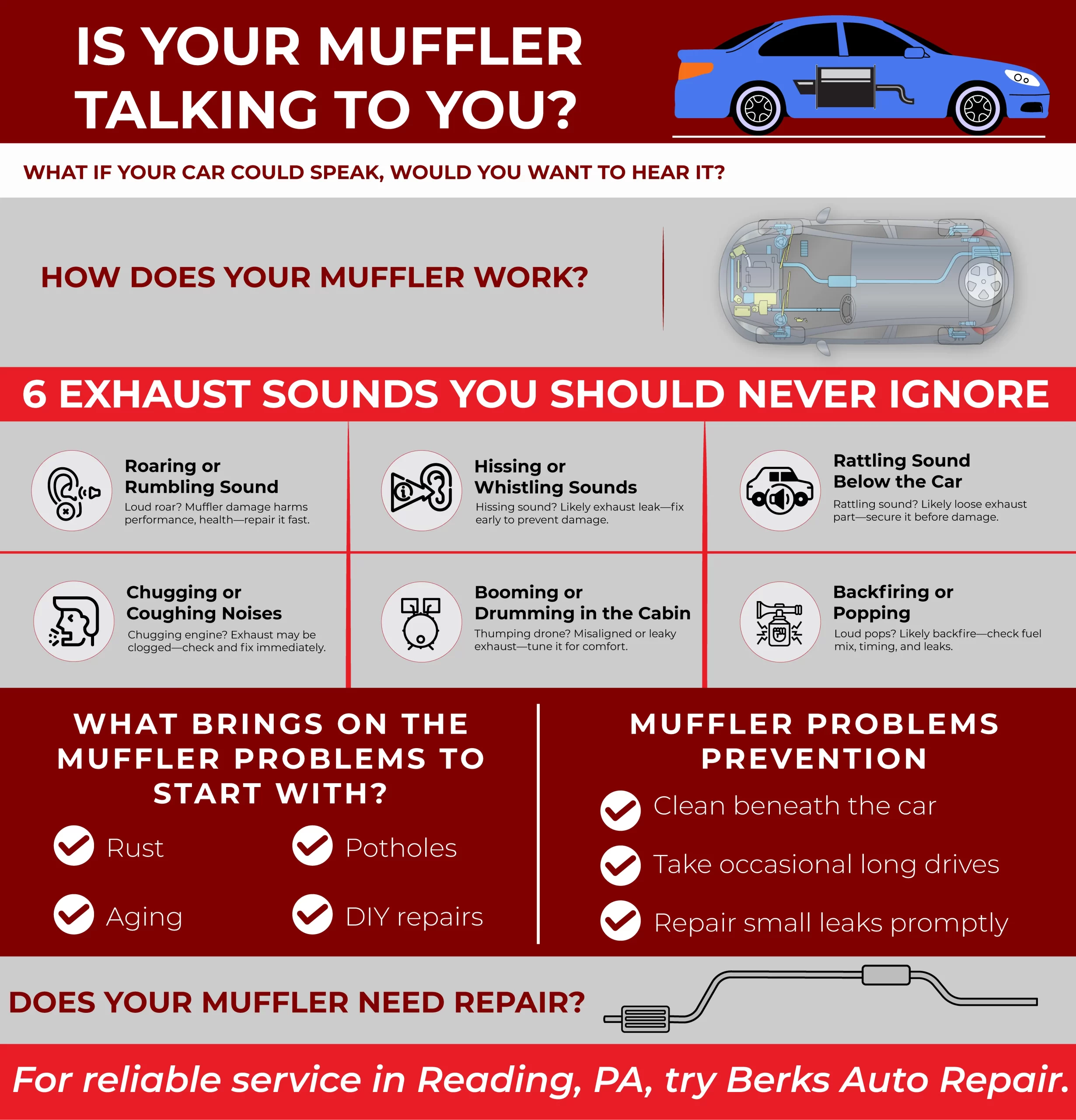
At other times it is speaking--but not speaking in words. Your car speaks a language of sounds and among the most talkative parts is the muffler. That rumbling grunt, hissing whimper or clanking rattle might not appear to be a big deal but these are the warning signals that your car is giving you in the form of a red flag. Neglecting them may cost a lot of money in repairs, cause emission failure, or even hazardous driving.
Today, we are going to reveal the six particular muffler sounds that you must not disregard in this article. We will tell you their meaning, the reasons they occur, and how to proceed further.
Just before we dive right into the sounds, let us briefly learn the purpose of a muffler.
Your car has a muffler which is exhaust system. Its primary work is to reduce the amount of noise that is caused by the exhaust gases in the engine. It also assists in routing exhaust out of the system with effectiveness. A well-exhaust muffler will decrease the emissions, enhance fuel efficiency and make your ride quiet and smooth.
When it begins giving strange signals in terms of sound then this is an indication that something is not functioning as it is expected.
Just think of your quiet car transforming to a muscle car overnight. The engine sounds louder, aggressive and so probably embarrassing at stoplights. That thunderous growl would be exciting in a racing car--but not when one has not expected it.
A roaring sound is a good indication of a hole or a crack in the muffler or the exhaust system. In the majority of cases, it indicates that the muffler is rusted out or corroded. This is predominant especially in regions that have salted winter roads or tend to have high moistures.
It also could roar due to the exhaust pipe being disconnected that interferes with the work of the muffler that is to dampen the sound.
In addition to the noise pollution (and possible ticket in someplace) a damaged muffler can:
Get your car to a reliable auto repair as soon as possible. The muffler and the whole exhaust system can be checked by a technician. In case of localized damage, it can be limited to a muffler replacement. In case the corrosion is more extensive, a bigger exhaust repair might be required.
A hiss, like that of steam coming out or air rushing out of a tire.
This normally indicates a leak in the exhaust manifold, or a crack in the exhaust pipe. Leaks resulting in this will allow hot exhaust gases to escape before they reach the muffler resulting in a high-pitched hiss or whistle. It can also be a sign of a broken gasket between the manifold and the cylinder head in other instances.
Even minor exhaust leaks lead to problems like:
Ask a mechanic to do a smoke test or employ a stethoscope tool to get the precise area where the leak is happening. Timely sealing or replacement of parts will save you the more extensive repairs in the future.
A rattling noise, of a metallic nature, more particularly heard at idle or during acceleration.
It could be a small number of things:
When the rattle sounds different or goes away when you accelerate or decelerate, that is a good indication of a loose piece.
What may seem like a simple nuisance can very easily become hazardous. A dangling exhust portion may scrape along the ground or worse still become detached posing a road hazard.
Crawl (safely) under the car or take it to a mechanic and have them check to see if there are any loose parts. Heat shield replacement or muffler rehanging is often free and fast.
A spluttering engine sound or an uneven chug-chug sound and usually poor acceleration or stalling.
These symptoms normally indicate that the exhaust system is clogged or partially obstructed. It may be a plugged catalytic converter, a plugged muffler, or a crushed exhaust pipe. It may also point towards unburnt fuel which may happen due to a faulty oxygen sensor, fuel system problem or deteriorating spark-plugs.
Limited exhaust flow causes:
This one is more of an immediate problem. A scan at an auto shop can verify trouble codes, and a backpressure test can verify a clogged exhaust. Repair can include Catalytic converter or muffler cleaning or replacement.
A low pitch vibration or thumping that you can feel in your chest or ears mainly when cruising at highway speed.
This is called exhaust drone and is commonly the result of an aftermarket muffler or custom exhaust system that has not been tuned. Nevertheless, it might also occur when:
Exposure to droning sounds can cause fatigue and headache especially when it is prolonged. It can also drown other useful noises of your engine or tires.
Have a muffler man look and see if he can add a resonator to reduce drone or replace the muffler. The sound can also be dissipated by realigning the exhaust system.
Loud popping or gun like noises occurring in the rear of your vehicle, usually when you are decelerating or changing gears.
Such sounds occur because of the unburnt fuel that burns in the exhaust. This may come about as a result of:
Backfiring is not just a simple nuisance; it is an indication that there is something not balanced in the combustion or exhaust system. It can:
With a diagnostic scanner, a mechanic can test air-fuel mixture, spark timing, and emission system. Repair can include re-tuning of the engine, changing bad sensors, or fixing exhaust leaks.
Knowing the cause may aid in preventing the issues before they arise:
Just because your muffler is not producing noticeable noise, be on the alert to these silent indicators of problems:
It is always good to be initiative. What may cost you a little repair now, will save you the whole exhaust system replacement later.
The following are some few prevention tips to help prolong the life of your muffler and exhaust system:
That muffler on your car is not simply there to keep your car silent, it is a vital component of your automobile wellbeing and safety. Its sounds can be helpful hints on what is wrong under the hood or in the undercarriage. Whether they roar and rattle, hiss and pop, these six sounds are the warning lights of the audio kind. The faster you can listen and take action the better your vehicle and your wallet will thank you.
Next time, when your car is talking, do not raise the volume on the radio. Listen. Your muffler may simply be attempting to rescue your engine, your emissions test-or your life.
Even if you are just noticing some of the signs that we have mentioned, do not wait. Minor issue may avalanche into a major one. Locate a reputable auto repair shop in your area and request them to check the entire exhaust system.
If you want a recommendation, Berks Auto Repair is the most reliable in Reading, PA.
A loud muffler is a sure indication that you have a hole, crack or rusted exhaust system. It might also imply a loose pipe or ruined internal parts such as baffles. Get it checked before more severe problems occur.
Your car may continue to run but it is not safe to be driving with a noisy or damaged muffler. It may seep carbon monoxide into your cabin, damage your engine and cause poor fuel economy and emissions violation.
Hissing or whistling sound is usually a sign of a minor leak in the exhaust pipe or manifold, or a blown gasket. This leak may emit poisonous gases and needs repairing as soon as possible.
Repair of the muffler may require an amount of money ranging between 100-400 dollars depending on the severity of the damage. Replacement of the entire exhaust system can be more expensive- up to $1,000 or even more- particularly when the catalytic converter is affected.
Yes, a failed muffler may develop backpressure to the engine efficiency. It is capable of decreasing horsepower, reducing gas mileage and eventually causing overheating or misfires.
The muffler makes the engine less noisy, and the catalytic converter checks the emission by changing the harmful gases to less harmful ones. They both belong to the exhaust system however have different purposes.